

|
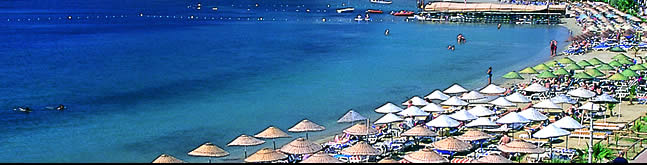
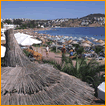
The History Lesson Gumbet is a holiday resort created to provide the usual facilities expected from a beach holiday. Unlike nearby Bodrum, Gumbet has a long beach curving around a bay, and the space for the hotels and apartments required to accommodate an expanding package holiday industry. The centre of Gumbet comes alive at night with several kilometres of rope lights in every conceivable colour stretched around the outlines of almost every building, restaurant and disco bar. Flashing neon lights complete the picture in a final attempt to lure the passing tourists. Disco bars thrash out this years and yesteryears sounds, mingling together in the narrow streets, while restaurants tempt the unwary with promises of Chinese, Indian, Italian, Mexican, Japanese, Thai and even Turkish food, all from the same kitchen. As the sun comes up it's time for a traditional breakfast bowl of soup to help soak up the excesses of the night, a couple of hours sleep, an afternoon posing on the beach, and another night on the town. Mountains close by. Good snow conditions are between November and May. |
The architect of the monumental tomb was Pytheos, and the relief engravings were made by sculptors such as Skopas, Leochares, Bryaxis and Timothes. The stones of the monumental tomb which was ruined by an earthquake in the 14th century, were used by the Knights of Rhodes in the construction of the fortress that exists today. The tendrils found in the tomb and the statues at the top, are kept at the British Museum today. When Artemisia II died in the year 351 B.C., she was succeeded by Idrius who was in turn succeeded by Ada, who was dethroned by her brother Pixodaros. Meanwhile Alexander the Great entered Anatolia and made Ada ascend the throne. 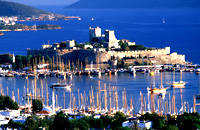 The Queen’s tomb,
discovered in recent years, is displayed at the museum today. The city
which was captured by Lysimachos following the death of Alexander the
Great, was later subjected to Rhodes and Pergamum, and still later Rome
got hold of Anatolia totally. Owing to the fact that Bodrum was founded
upon the ancient city of Halicarnassos, not much is left to our day from
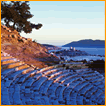
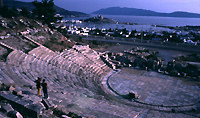
the ancient city. The theatre, the stoa of Mars and Apollon situated
within the gardens in the city, the theatre on the hill belonging to the
Hellenistic period have been restored today. Former sources of
information state that, the temple of Mars and the stoa of Apollon were
under the road in front of the theatre, and the temples of Hermes and
Afrodities were on the public square of today. The Queen’s tomb,
discovered in recent years, is displayed at the museum today. The city
which was captured by Lysimachos following the death of Alexander the
Great, was later subjected to Rhodes and Pergamum, and still later Rome
got hold of Anatolia totally. Owing to the fact that Bodrum was founded
upon the ancient city of Halicarnassos, not much is left to our day from
the ancient city. The theatre, the stoa of Mars and Apollon situated
within the gardens in the city, the theatre on the hill belonging to the
Hellenistic period have been restored today. Former sources of
information state that, the temple of Mars and the stoa of Apollon were
under the road in front of the theatre, and the temples of Hermes and
Afrodities were on the public square of today.
There are not many Turkish works in Bodrum. The famous crafts called The Crafts of Bodrum today, were constructed here during the Ottoman period too.
|
|||||||||

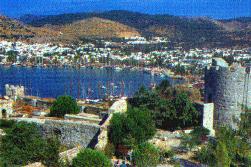

 The fortress is the city
symbol. The Knights of Rhodes had it constructed in the year 1402, and
it was reinforced with the Italian, English, German and French towers.
It was taken by the Turks in 1523, and it is used as an underwater
museum today. The underwater section and the section of Princess Ada,
are the sections which attract the greatest attention here.
The fortress is the city
symbol. The Knights of Rhodes had it constructed in the year 1402, and
it was reinforced with the Italian, English, German and French towers.
It was taken by the Turks in 1523, and it is used as an underwater
museum today. The underwater section and the section of Princess Ada,
are the sections which attract the greatest attention here.